

From Budgets to Building
The FY2027 state and city budgets—what we got, what it cost, and what comes next

We have been focused on the coming primaries—early voting starts June 13 and lasts until June 21. Election Day is June 23. We urge you to take a look at our voting guide, stay tuned here for any updates. Get involved by signing up to volunteer for our coming day of action events (for Ryder Kessler tonight and Antonio Reynoso on Sunday!).
When not watching the electoral news, we’ve been watching the budget.
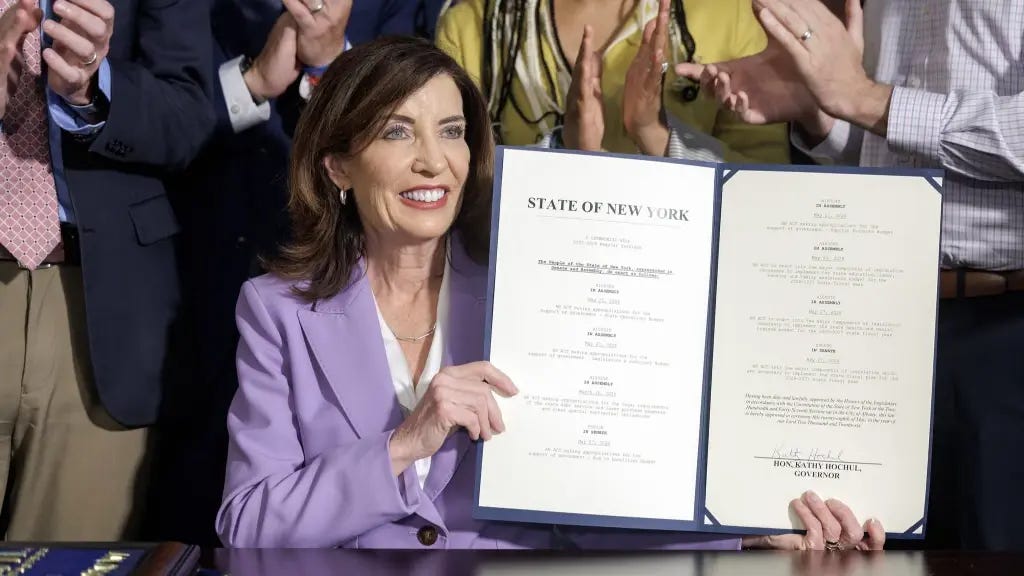
After months of uncertainty and sometimes contentious back-and-forth, New York is in the budget season homestretch. The state budget landed 57 days late—the latest since 2010. In the city, after a delay caused by the state’s tardiness, Mayor Mamdani has put forward an executive budget that incorporates lots of the city council’s own work, which we expect to pass more or less as is by the end of the month.
In the end, the state and city’s leaders have decided to push the fiscal fights for another year. Hochul and Mamdani plugged the city’s budget hole through one-time spending and state aid. Hochul continued to spend slightly more than the state can sustain and instead fought for her policy changes. Menin found a much cheaper tax on the wealthy to offer the mayor. And so, we end the budget season with a lot of exciting policy wins, but without a much clearer view of the long term fiscal trajectory of the state.
The State Budget
Most people have noticed by now that the budget was very, very late. The governor points out that many voters don’t care about the lateness as long as something good eventually happens. She may be right, but the lateness is an issue for a wide range of organizations that are downstream from an enacted state budget, including all local governments, schools, and nonprofits. The Assembly Speaker Carl Heastie also criticized Governor Hochul for her policy-forward approach to the budget negotiations. Hochul isn’t going to yield; she has more leverage during budget negotiations and it is perfectly understandable to want to change rules while you decide on resources. Rather than complain about the governor’s tactics, legislators would do well to come to these talks prepared with policy and budget demands of their own. Finally, while the City has been the focus of more attention for its deficit, watchdogs commented that the State’s budget, despite higher than expected tax revenues (driven by a gravity-defying stock market), still did not contribute savings to a rainy day fund nor fix a looming structural gap.
SEQRA Reform
As we recommended in our agenda and supported through the Unlock NY’s Future coalition, the budget enacts the most significant reform to the State Environmental Quality Review Act since its passage in 1975. SEQRA reviews add up to two years to project timelines and up to $82,000 in per-unit costs for New York City housing. The reform creates new “Type II” status—exempting projects from any review—for housing on previously disturbed land connected to existing public water and sewer up to 250 units citywide in New York City (up to 500 in medium- and high-density residential or mixed-use districts), up to 300 units in urbanized areas outside NYC, and up to 100 units in non-urbanized areas. Beyond housing, the law adds Type II status for clean water infrastructure, green infrastructure, public parks and trails, and new school buildings built by the NYC School Construction Authority. For projects still requiring review, the law establishes a two-year hard deadline to complete an environmental impact statement and a shortened statute of limitations for challenges.
Coming just a few years after the state legislature rejected Hochul’s housing compact, this is a massive victory for the abundance movement and a sign that legislators are coming to understand the role that broken processes play in denying New Yorkers homes. We hope that this win sets a precedent—we do not simply have to live with rules that are not working for us, and changing them can benefit a wide range of stakeholders and causes, from affordable housing to clean energy and economic development.
Climate
We have written about our opposition to rolling back CLCPA targets and our view that New York should focus on making it easier and cheaper to meet our climate targets, not move them. In the end, the budget did a little of both.
The bill rolls back the implementation deadline for required GHG regulations to the end of 2028 (Hochul had asked for 2030), shifts New York’s GHG accounting to a 100-year standard for methane (which seemed reasonable when Hochul requested it), and pushes the electric school bus mandate back five years to 2032. However, the bill also enacts reforms that will make it easier to install distributed solar power throughout the state and we expect more to come. We think the state could be doing much more to meet its climate goals while lowering bills, but the shortened 2028 deadline means that this issue will stay on the agenda for further discussion.
Pied-à-Terre Tax
Those of us who support building a lot more housing in New York to counter higher housing prices often face a challenging retort—what about all those condos the oligarchs own? Of course, the oligarchs have not caused the city’s housing crisis and building more is the way out, but the problem has political salience. In a place as desirable as New York City, those with means will always want to own a piece of the city, maybe as a vacation home or as a financial asset. In our agenda, we called for a tax on vacant second homes as part of property tax reform. While there is still a lot to figure out, and the revenue projections likely won’t come to pass, we are excited about the version that the budget enacts.
Auto Insurance
New Yorkers pay more than most of the country for auto insurance—driven in part by fraud, litigation abuse, and weak statutory limits on bad-actor payouts. The budget enacts significant tort reform, makes insurers apply for state approval before raising rates, and returns any excess profits to policyholders. While we have no sympathy for reckless drivers, insurance fraud drives up costs for all kinds of transportation and consumer goods. Florida’s similar 2023 reforms produced a 7.4% rate reduction within two years. The politics are also interesting. Trial lawyers, long considered invulnerable, lost. We would love to see this fight turn into precedent for reforms to the state’s Scaffold Law, a fight with similar, but tougher, dynamics.
The City Budget
Below the fireworks between the mayor and the speaker, real work continued on the city budget. The mayor, despite his criticism of the council speaker, listened to the body’s rejection of property tax increases and spending of the city’s reserves—both are gone from his executive budget. The mayor has also accepted council-identified savings from competitively bidding Department of Education contracts and auditing non-essential spending, and spending more for libraries, parks, CUNY, and cultural organizations.
The mayor closed the city’s budget deficit through a few mechanisms: 1) agency savings ($1.77 billion over FY26–27 from chief savings officers); 2) program cost containment ($1.2 billion, mostly from delaying implementation of laws to reduce class size and expand housing vouchers); 3) delaying pension fund payments ($1.6 billion); 4) rerouting state revenue to the city; and 5) new revenue (mostly the second homes tax). The pension “gimmick” moves the paydown deadline on the city’s unfunded pension liability from 2032 to 2037, which frees cash now at the cost of larger payments later. This is the kind of move cities in crisis are forced to take. New York’s economy is strong and it simply should not have come to this. That said, we are excited that the mayor is interested in proposals to amend the city charter to make the government more efficient, a mantle that Elon Musk never should have been allowed.
The transportation budget, the largest in history, is the clearest abundance win in the city budget. With this funding and 115 new DOT hires, we hope the agency is equipped to implement plans that call for more busways, bike lanes, and pedestrian improvements. We appreciate that the mayor is moving forward on fast buses by funding the system change that speeds New Yorkers’ commutes. We are also excited to see funding for the implementation of safer speed limit law (Sammy’s Law) and trash containers.
However, we are dismayed that the mayor has committed $43 million to begin construction of a park connected to QueensWay, a proposal that creates a welcome park in a transit desert section of the borough, but prevents the reactivation of an existing rail line there, the proposal for which is called QueensLink. The mayor had previously supported the transit project, which already has $500,000 in federal and state study grant funding. It is not clear whether City Hall believes the park funding leaves room for a later subway expansion, which would be a mistake, or if the mayor has decided to avoid the ire of NIMBYs who oppose the project, which would be disappointing. Either way, we hope that the council does the right thing and chooses transit and parks over parks alone.
The mayor and the council have until the end of the month to pass a budget. The hard work appears mostly finished, but there’s always time for a surprise at the end.